HEELIA
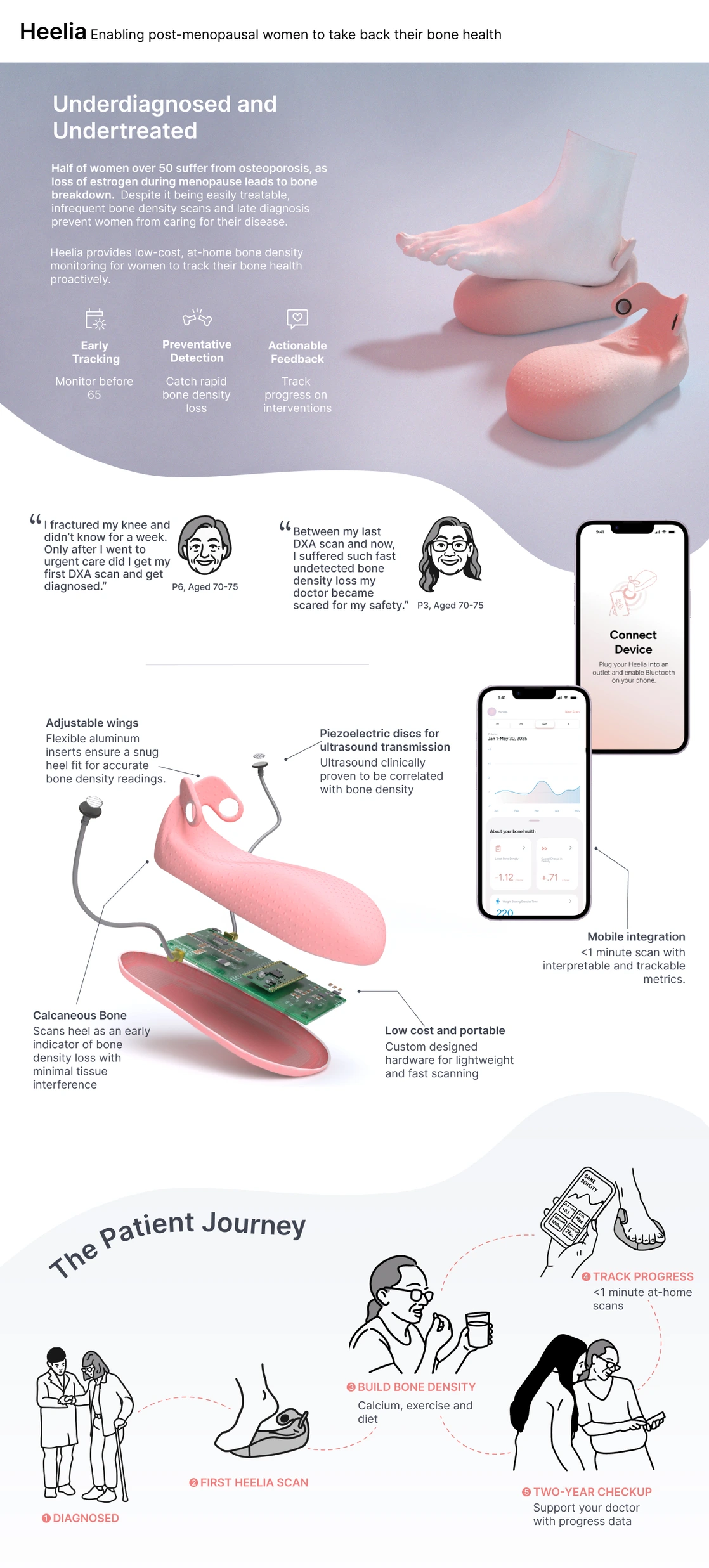
Half of women over 50 have osteoporosis. Yet it is easily treatable; yet late and infrequent screening at 65+ and every 2 years blocks patients from proactive action. Heelia is a low-cost, at-home ultrasound monitor that aims to democratize bone health care for women.
Collaborators: Michelle Hui, Reitwiec Shandilya
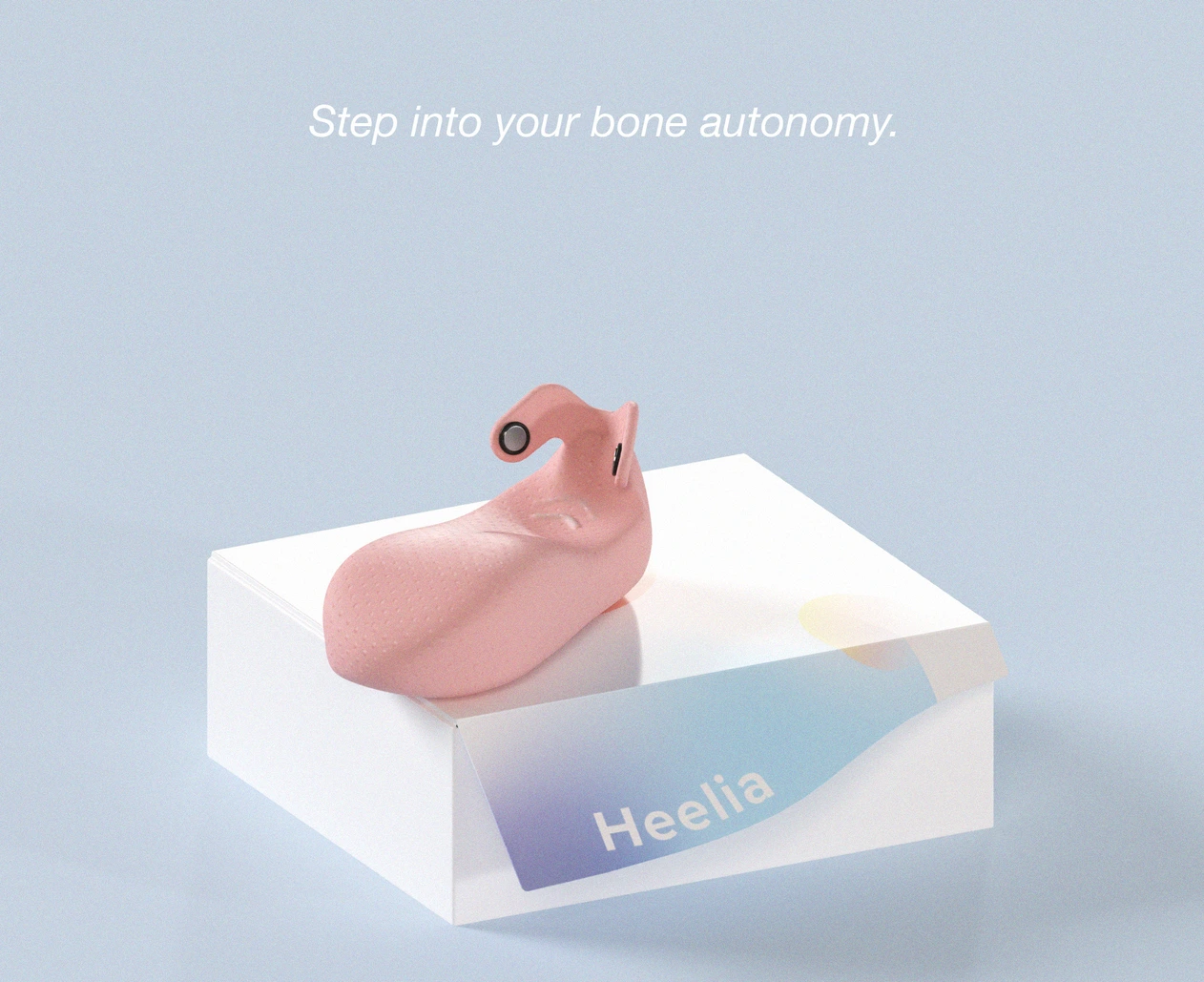
What Differentiates Heelia
Heelia is the first and only affordable, at-home bone density monitor designed for women on the market. Medical DXA scans used for osteoporosis diagnosis are late, infrequent, and clinic-bound. Existing portable ultrasound devices on the market, using similar technology to Heelia, cost over $10,000. Heelia's prototype costs just $150, with potential to go below $100 with design optimizations and scaling using our custom low-cost Raspberry Pi Pico hardware.
During user interviews, one woman shared how she had to fight both doctors and insurance for her first scan, only to receive a late diagnosis. Another said she couldn't understand her DXA results without her doctor. This lack of accessible monitoring prevents women from seeking care, despite osteoporosis being easily treatable. Heelia revolutionizes this by having the patient take control, translating complex data into simple, personalized insights, without waiting years or navigating medical barriers.
Inspiration
In 2022, Michelle's mom sustained a traumatic hand injury and was diagnosed with osteoporosis and rapid bone loss. She began taking calcium and doing weight-bearing exercises, but got confusing feedback at her 2-year checkup. Reitwiec's grandma suffered multilevel osteoporotic collapse from a minor fall, something an earlier intervention could've helped prevent. When we met at Cornell, women in our lives had similar stories. Despite the disease being easily treatable, the lack of feedback and awareness caused women to fear daily activities. We set out to improve the quality of life for women and help them manage their bone health proactively.
Patient Stories
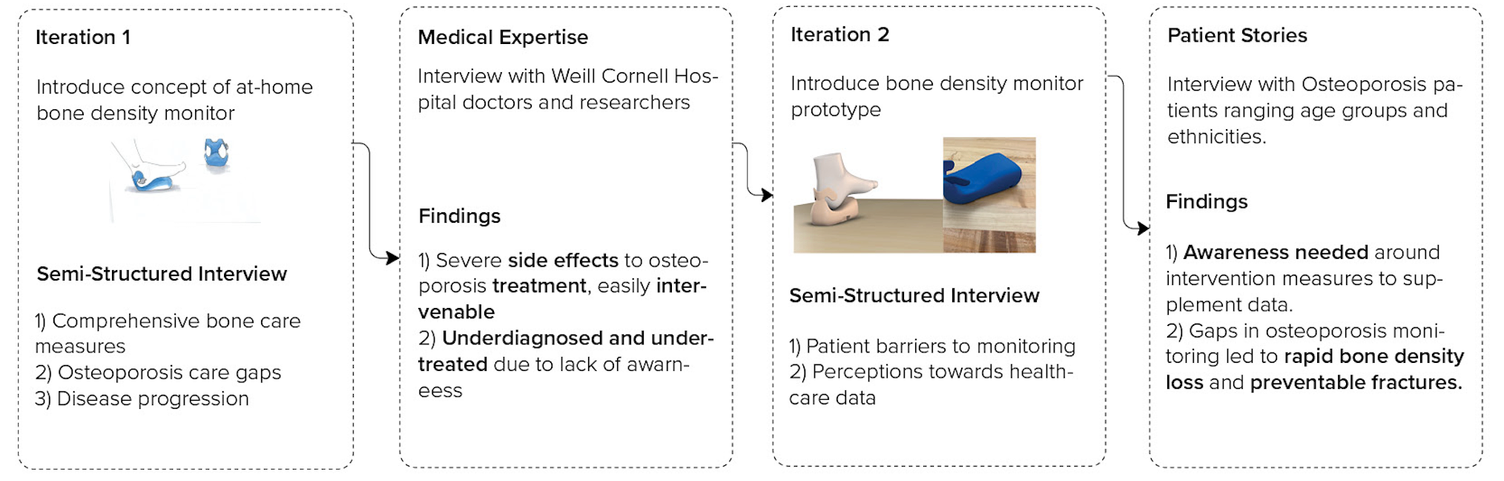
In early stages, we conducted background research and preliminary interviews to understand user needs and constraints. We interviewed five women (ages 55–70) living with osteoporosis or osteopenia and three clinicians specializing in osteoporosis. These interviews uncovered user priorities that guided our ideation. For example, participants stressed ease-of-use (“If it's complicated to operate, I might not use it regularly”) and data privacy (“I have concerns about a device having data on my bone health. If it just treats me as a user ID and not my name or age, I'd feel more comfortable,” P5, age 66). Users also expressed willingness to invest in a reliable solution — one interviewee said “I'd be willing to pay $200 or more for this, if it works well. If it's too cheap, I'd worry it isn't reliable.” These insights shaped Heelia's design: we focused on simplicity, trust, and transparency in both hardware and software.
Fabrication Pipeline and Iteration
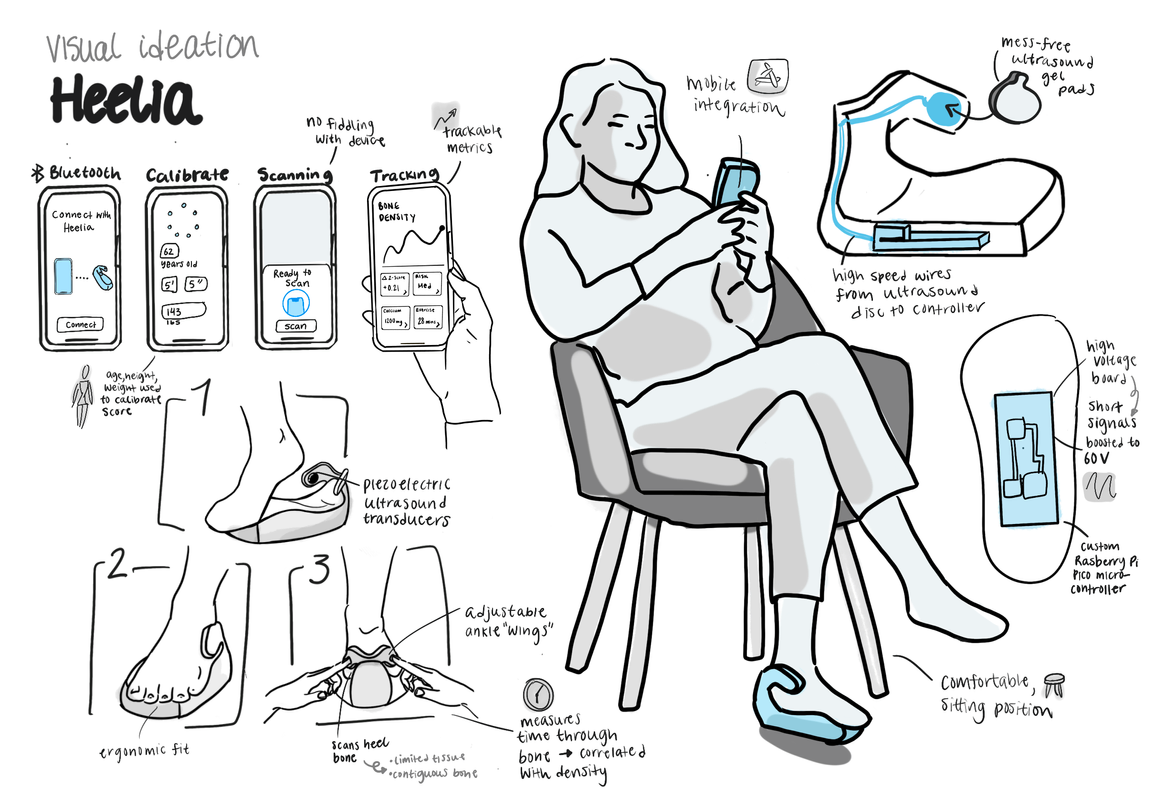
Taking user insights, we sketched dozens of concepts to problem-solve through key gaps and explored adapting ultrasound for home use.
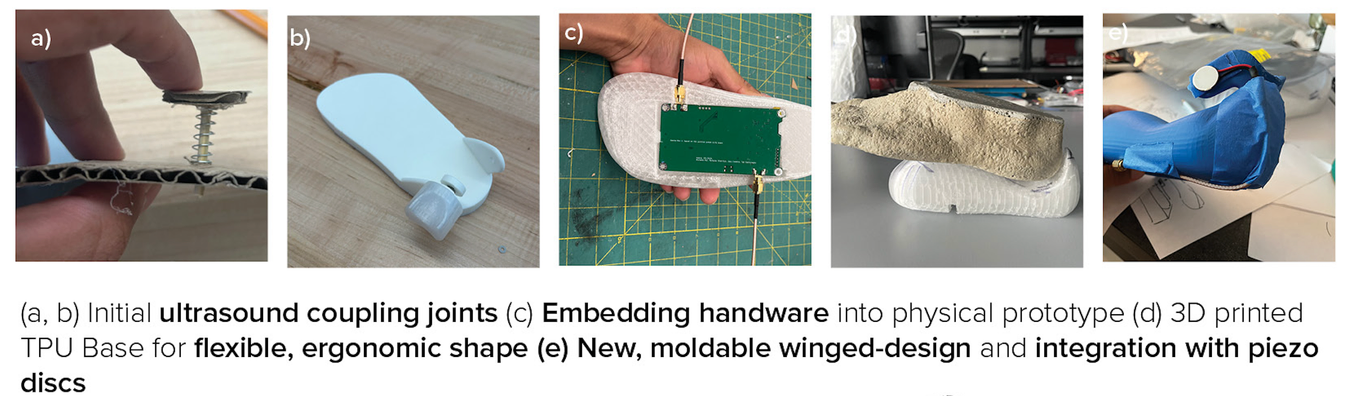
Learning from open-source projects, we repurposed humidifier parts and soldered our first custom hardware to keep costs low, successfully measuring bone density with ultrasound as a proof of concept. We further iterated on coupling mechanisms — including knobs, calipers, and ballet-inspired flexible wraps — to ensure comfort and signal alignment. A patient model tested our designs for comfort and efficacy.
We also tested materials like PLA, TPU, and silicone overmolding, and finally created a design featuring soft, user-friendly “wings” that mold securely to the heel. With each iteration, we simplified the hardware to minimize confusion, even opting for a display-free interface to build for all levels of digital literacy and meet patients with simplicity. Using CAD and 3D printing, we refined the form factor and embedded it with the hardware, validating Heelia's usability and efficacy through continuous testing and feedback.
Embedded Programming
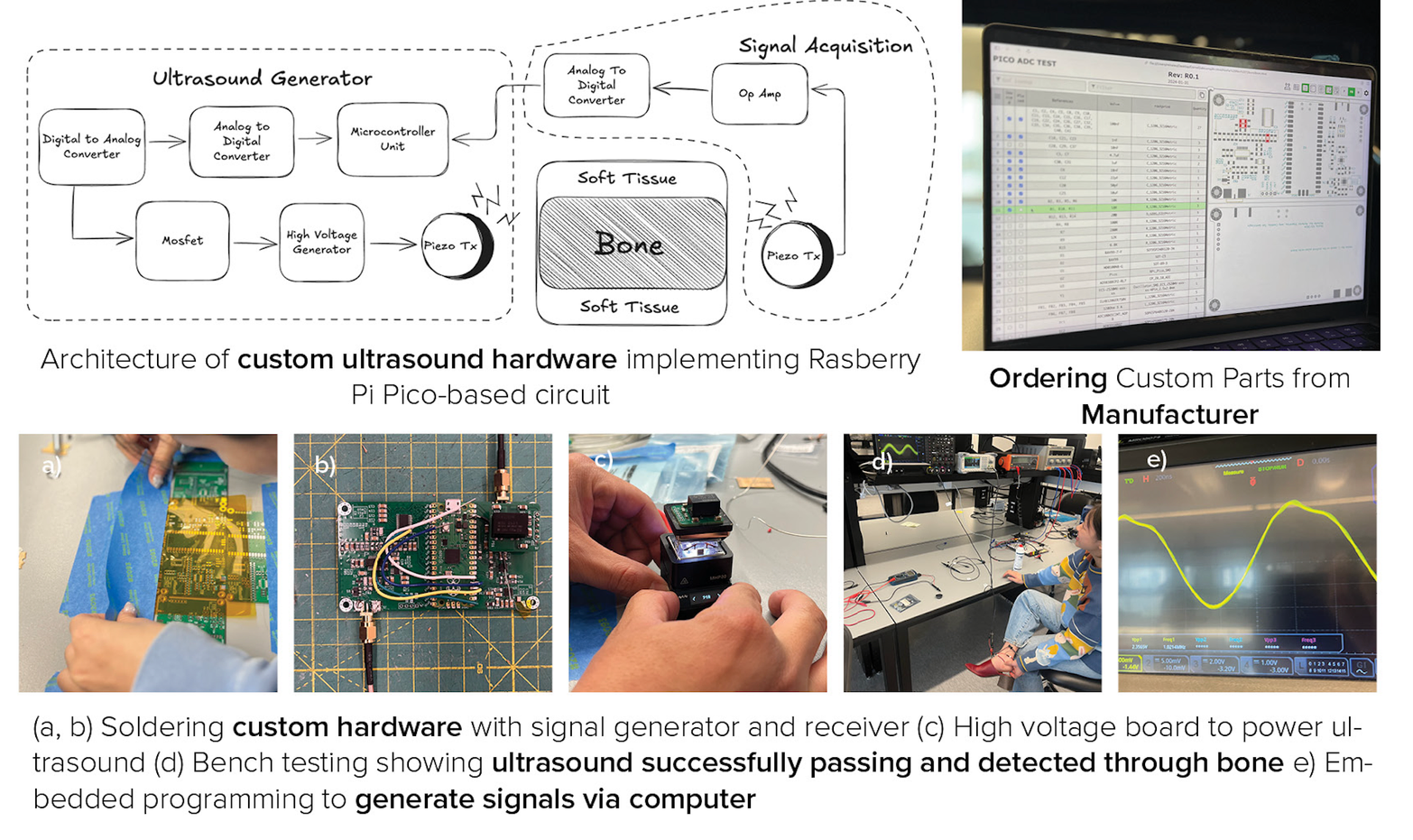
Our design repurposes existing literature and tech into a low-cost ultrasound scanner that measures bone density at the heel. It uses a Raspberry Pi Pico microcontroller ($10) to control a signal generator, which creates a 2.4 MHz ultrasonic wave — ideal for passing through bone. The sound is shaped into short pulses and amplified to 60 V to reduce signal loss. Two piezoelectric sensors, repurposed from humidifiers to cut costs, send and receive ultrasound on both sides of the heel. As the wave travels through the bone, the device records how long the wave travels and how much it weakens via high-speed sampling. The microcontroller processes this data and sends it to a smartphone app. A time delay algorithm calculates the Z-score, a standard metric comparing bone density to population values for age and body type. We chose the heel bone (calcaneus) through prior literature because it has minimal tissue interference and is an early indicator of bone loss.
Refining Usability
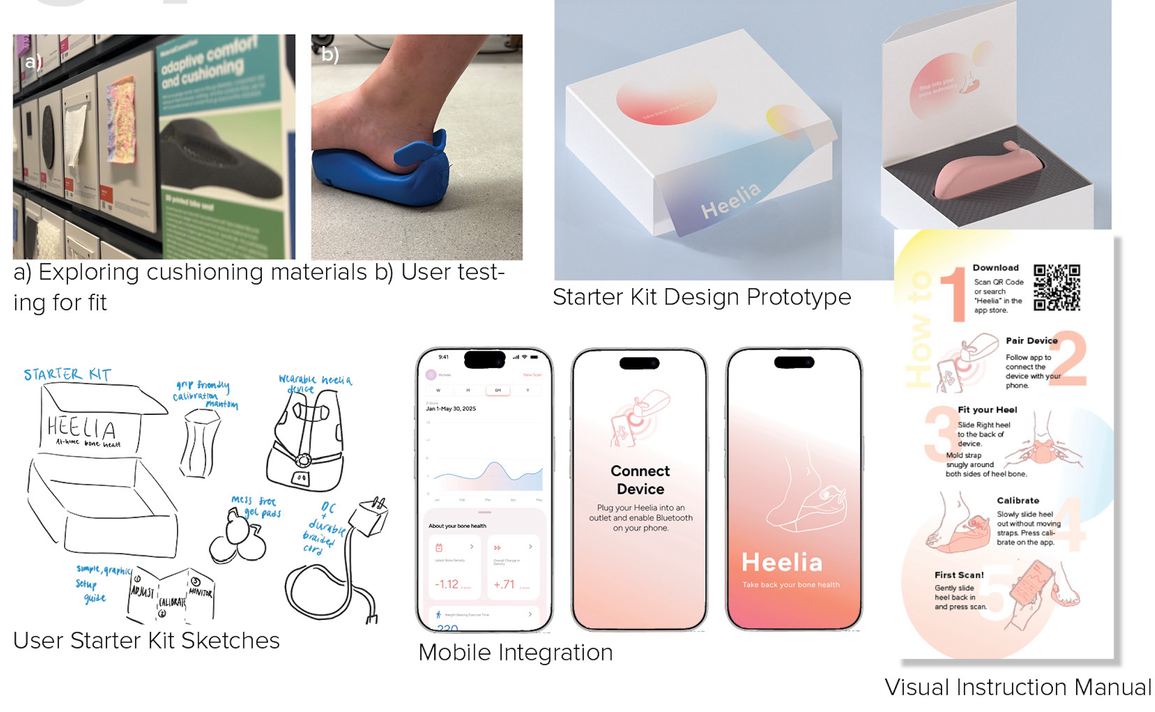
We also considered the user experience to enable our users — who have a baseline level of technical proficiency and smartphones — to onboard smoothly. We designed a graphic instruction manual and QR code for our app to integrate the Heelia device with long-term tracking and calibration.